AI Automation Cost Control Checklist: Set Limits Before Workflow Spend Escapes
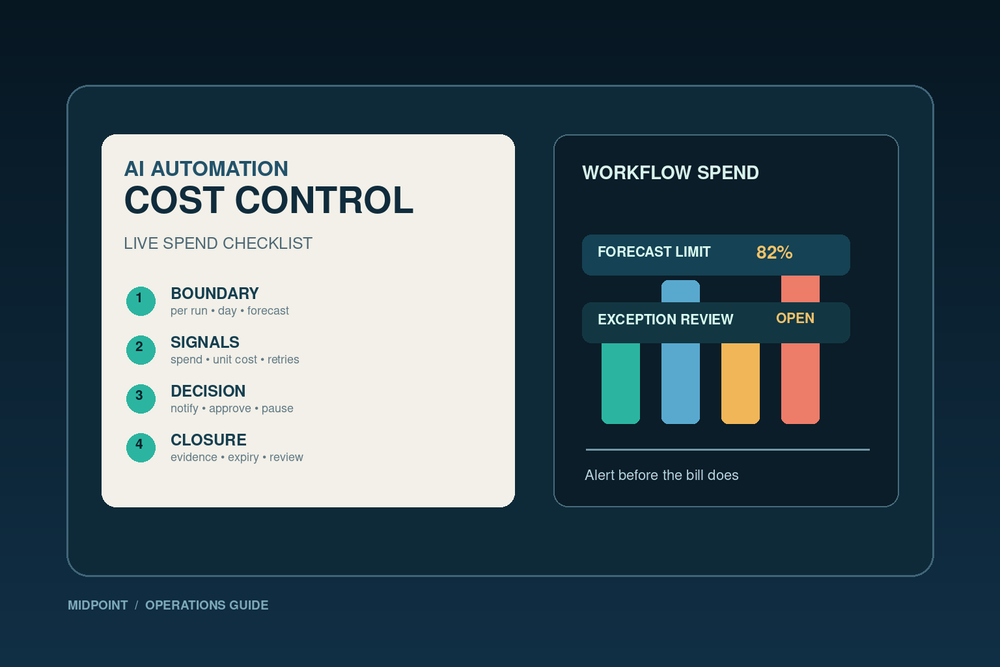
AI automation cost control is the set of operating limits that keeps a live workflow useful without turning an unusual input, retry loop, model switch, or new integration into an open-ended bill. This checklist helps an operator control spend while work is running. It focuses on four questions: what is the boundary, which signals show it is approaching, what safe action happens when it is crossed, and what evidence proves the exception was closed.
It does not replace an ROI model, an observability-tool comparison, change management, or an ownership model. For the financial case, use the AI workflow ROI calculator. For telemetry design, see AI agent observability tools. The narrower question here is: what will stop, slow, or require a human decision when consumption changes?
Start with a control boundary, not a single monthly number
Write one boundary for each important workflow or customer-facing capability. Name the scope, time window, currency or usage limit, leading signal, safe action, and evidence source. Scope might be a workflow, environment, customer, provider project, or model route. A useful action can notify, require approval, switch to a lower-cost route, pause new work, or stop the workflow. Do not invent universal thresholds. A per-run limit must be explainable by a named budget holder and revised when evidence says it is wrong.
Map every controllable meter to one working owner
Make a short meter map before adding alerts. Record what is counted, the attribution key, the control point, and the evidence source. Typical meters include model tokens, tool calls, retrieval or document processing, compute time, and retries. A workflow name alone is rarely enough attribution. Include the environment and the model route, provider project, queue, or feature identifier wherever the platform supports it.
FinOps guidance matters here because AI services introduce changing meters, shared services, and units such as tokens, requests, or training duration. If an invoice line cannot be tied to a workflow or approved shared-cost rule, treat that as a control gap rather than a reporting inconvenience. The owner should be able to answer what changed and which decision can enforce the boundary.
Use leading signals, not just a bill that arrives late
The cheapest time to control spend is before the invoice. Track actual spend against the current window, forecast to the window end, cost per completed business item, usage per run, retry and failure rate, and rate-of-change anomalies. Use a small alert ladder: notify and validate attribution at the early threshold; stop discretionary work or require approval at the decision threshold; and prevent new work at the hard boundary while preserving evidence.
Approval limits must say what is approved: a one-time exception, a higher temporary run ceiling, a premium model route, or a recurring budget increase. Record the approver, purpose, added unit cost, safe default, and expiry. A notification is not an automatic stop unless the platform is configured to make that change.
Make exceptions reviewable and close them
Every cost exception needs a record separate from the alert. Record the exception ID and opened time, affected workflow and allocation key, boundary crossed, observed signal, business reason, safe default, approver and approval time, expiry, incremental spend, closure evidence, and next review date.
Review open exceptions on a fixed cadence. The review should decide whether to keep the control, tighten or loosen a documented boundary, or repair an attribution or enforcement gap. “Monitor it” is not an outcome. For a practical operating loop, start with one workflow that has a real consumption path, give it a per-run boundary and a daily signal, require an approval with an expiry for the expensive route, and close every exception with evidence. A budget is a promise; a cost-control checklist is the mechanism that makes it believable.
More articles
AI Agent Incident Communication Plan: Templates, Cadence, and Evidence
A practical AI agent incident communication plan with severity criteria, stakeholder templates, status cadence, evidence, and follow-up.

AI Agent Data Privacy Checklist: Controls That Hold Up in Production
A practical enterprise checklist for classifying agent data, minimizing access, controlling retention and transfers, redacting evidence, reviewing vendors, and proving incident readiness.

AI Agent Observability Tools Compared: A Practical Buyer Guide
Compare eight AI agent observability approaches by traces, tool calls, evaluations, cost, privacy, alerts, deployment, and OpenTelemetry support.