AI Workflow Exception Management: Build a Queue That Turns Edge Cases Into Decisions
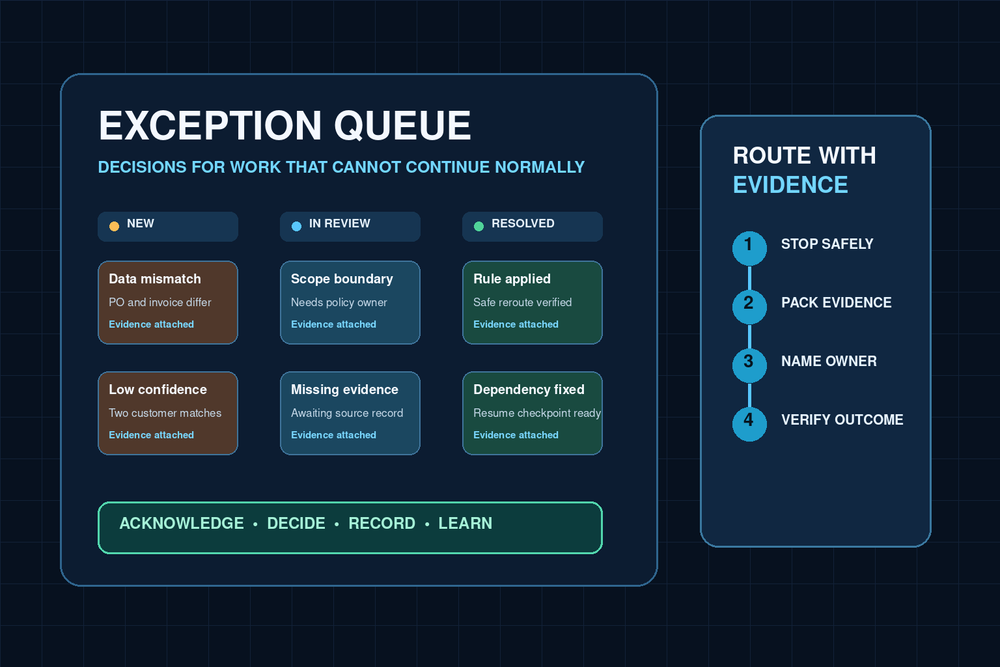
An AI workflow does not become trustworthy because it never meets an exception. It becomes trustworthy when the exception stops in the right place, with the evidence a person needs to decide what happens next.
A supplier invoice that does not match a purchase order, a customer record with two plausible owners, a request outside the agent's permitted scope, or a browser task that reaches an unfamiliar page are operational exceptions. They are not automatically incidents. They do not all need a rollback. And they should not become invisible work in a general inbox.
Use this guide when: a recurring workflow needs a reliable way to pause, route, resolve, and learn from non-routine cases without asking a worker or operator to improvise every time. It includes a copyable exception-queue schema for the human review queue behind an automated process.
This guide owns the queue between normal workflow execution and a bounded human decision. For severity definitions and incident response, use the AI agent incident severity matrix and the AI agent failure recovery playbook. For transferring routine work between specialists, use AI agent handoff patterns. For approval policy before a known high-impact action, use human-in-the-loop AI workflow approvals. Exception management is the operating system for the cases those designs deliberately leave unresolved.
What an exception queue is, and what it is not
An exception queue is a durable, owned record of work that cannot continue through its normal route. The queue stores the item, why the workflow stopped, what has already been attempted, the evidence needed for a decision, the person or team responsible, a service target, and the final resolution code.
It is not a dump for every failed task. A transient API timeout may belong in a bounded retry policy. A confirmed customer-impacting outage may become an incident. A known payment threshold can require an approval before execution. The queue is for the remaining category: a case that needs judgment, missing information, or an authorized alternative route.
The distinction matters because a queue changes the question from “did automation fail?” to “what decision is needed, by whom, and by when?” A well-designed queue protects throughput without hiding risk. A bad one turns every edge case into a vague ticket that nobody owns.
Start with exception classes that lead to an action
Do not classify exceptions only by the technical error message. Classify them by the next operating move. Keep the first taxonomy short enough that routing is dependable.
| Exception class | Example | Normal next action |
|---|---|---|
| Missing or conflicting data | Invoice total conflicts with the PO; two customer records match | Request evidence, correct data, or choose a source of truth |
| Policy or scope boundary | Agent is asked to export outside its approved folder | Route to the policy or resource owner for a bounded decision |
| Ambiguous intent | A support request can mean refund, replacement, or troubleshooting | Ask the requester or a designated owner for clarification |
| External dependency | A required vendor field is absent or a downstream system rejects a valid record | Hold, notify the dependency owner, and resume only from a safe checkpoint |
| Quality or confidence failure | Extraction confidence is below the documented threshold | Human review, correction, or a limited re-run |
| Safety-sensitive condition | A result would create an external, financial, legal, privacy, or reputational consequence | Pause and route under the applicable approval or incident rule |
This is not a severity matrix. Severity decides how much impact and escalation an incident requires. Exception class decides which queue, evidence packet, and resolver can move ordinary work again. Keep an explicit “incident candidate” flag for cases that cross the severity threshold, then route them out of the operational queue rather than trying to run a crisis process inside it.
Define the stop rule before the workflow runs
The workflow should be able to explain why it stopped in a sentence a resolver can understand. A useful stop rule names the observation, the threshold, the safe state, and the route.
For example: “Stop invoice posting when the PO variance exceeds the allowed tolerance or the supplier record has more than one active match; preserve the extracted fields and source document; do not create a draft; route to Accounts Payable Exceptions.” That is far better than “error: validation failed.”
For every stop rule, decide four things:
- What may continue safely? Preserve completed, idempotent work and identify the last safe checkpoint.
- What must not happen? Prevent a draft, send, record change, export, payment, or retry that could make the ambiguity worse.
- What evidence must travel? Include the input, normalized data, checks run, confidence or policy result, and any external record IDs.
- Who owns the next decision? Name a role, backup, and escalation path rather than a generic “ops” destination.
The safest response to uncertainty is not always to stop everything. It may be to complete the non-consequential portion, save a reviewable draft, and queue only the decision boundary. That preserves flow while keeping authority visible.
Build the evidence packet a resolver can actually use
A resolver should not have to reproduce the run to understand the case. Give them the smallest packet that proves the reason for the exception and supports a decision.
A practical packet includes:
- a stable exception ID and the workflow run or business-record reference;
- the original request or source location, with access controls appropriate to the data;
- normalized fields and the exact validation, policy, or confidence rule that stopped the route;
- the action the workflow did and did not take, plus the last safe checkpoint;
- candidates or alternatives when matching, routing, or classification is uncertain;
- the expected business impact, deadline, and SLA clock;
- prior related exceptions or a link to the operating record; and
- a proposed safe next action, clearly marked as a proposal rather than a decision.
The packet is not a replacement for audit logging. An audit-trail design retains the full protected event history. The exception packet is a decision view: enough evidence for a reviewer to decide without making them hunt through raw logs. Link to AI workflow audit trail requirements when a team needs the underlying event and retention design.
Route by decision authority, not whoever looks available
Routing is the heart of automation exception handling. The right recipient is the person or team authorized to resolve the specific ambiguity, not necessarily the workflow builder or the person who noticed the queue.
Use a clear routing ladder:
- Auto-resolve only when the rule is documented, reversible where needed, and evidence is preserved.
- Named operational resolver handles routine data correction, customer context, or bounded business choices.
- Resource, data, or policy owner decides a scope boundary, retention, access, contractual, or compliance question.
- Decision owner or approver accepts a material but known consequential action under the approval policy.
- Incident path takes over when actual or credible impact meets the incident threshold.
A handoff design tells you how one worker passes completed context to another. An exception queue tells you when normal handoff is no longer enough and who has authority to choose the new route. Do not ask a resolver to infer authority from the wording of a ticket. Put the resolver group, accountable owner, and escalation fallback directly on the queue record.
Keep reason code, lifecycle state, and resolution code separate
Three fields often get collapsed into one vague label. Do not do that.
- Reason code explains why the workflow stopped: missing data, scope boundary, ambiguous intent, dependency, quality failure, or safety-sensitive condition.
- Lifecycle state tells the operator where the record is now: new, acknowledged, waiting for evidence, in decision, resolved, or escalated.
- Resolution code explains how the case reached its outcome: data corrected, rule applied, request clarified, rerouted, declined, dependency fixed, incident escalated, or automation changed.
The separation makes queue data usable. A case can have the same reason code and a different resolution each time; it can be acknowledged without being resolved; and it can be escalated without pretending the business item is complete. These are editorial operating recommendations, not a universal standard taxonomy.
Put an SLA on acknowledgment and resolution
A queue without time behavior is just a backlog with better labels. Give each class two clocks: first-review acknowledgment and final resolution.
Acknowledgment answers, “Has the correct owner accepted this decision?” Resolution answers, “Has the case reached a terminal outcome or been safely escalated?” They should have different targets. A high-volume data mismatch might need acknowledgment within one business hour and resolution within one day. A low-risk content ambiguity may have a next-business-day target. A safety-sensitive boundary needs immediate notification and a defined containment rule.
The SLA should include calendar rules, a backup route, and what happens at breach. Escalating a stale item is not a failure of the original resolver; it is a guard against silent abandonment. If the item blocks a customer commitment or a downstream batch, expose that dependency so the owner can choose an honest mitigation instead of quietly waiting.
Never use a timeout as implied approval. On timeout, either hold safely, route to a fallback decision owner, downgrade to a safe draft, or move the case to the incident path. The correct default depends on the consequence, but it must be explicit before volume arrives.
Use resolution codes to make the queue learn
Free-text closure notes are useful, but they cannot tell you whether the same exception is eating the workflow every week. Require a short resolution code, then collect the detail beneath it.
Start with a stable set such as:
- data_corrected: source or normalized record was corrected;
- rule_applied: documented policy selected the route;
- approved_exception: a named owner authorized a bounded departure from the normal rule;
- request_clarified: the requester supplied the missing intent or evidence;
- rerouted: another authorized process or owner took the work;
- dependency_fixed: a downstream system or partner corrected the blocker;
- declined_or_cancelled: the requested outcome should not proceed;
- incident_escalated: the item crossed the incident threshold; or
- automation_changed: a tested workflow change prevents the recurrence.
Pair the code with the resolver, decision rationale, evidence link, completion time, and whether a follow-up action remains. “Resolved” alone is not a learning signal. A code makes it possible to see, for instance, that duplicate customer matching is a data-stewardship problem while missing vendor fields are a supplier-onboarding problem.
Close the feedback loop without silently expanding automation
Review exception patterns on a cadence tied to volume and consequence. A weekly review may be appropriate for a busy operations queue; a monthly review may suit a lower-volume finance control. Look for volume, age, breach rate, resolver load, reopen rate, resolution-code mix, and the share that cross into an incident or approval route.
Use the review to decide among four responses:
- fix upstream data or integrations;
- improve queue evidence or routing so people decide faster;
- add a narrowly tested automation rule for a repeated, low-risk case; or
- keep human review because the variation is real and the consequence is material.
Do not treat a high count as proof that the workflow should automatically decide the case. First look for a bad source system, an unclear policy, a missing owner, or an incentive that produces junk inputs. Automation should remove a proven, bounded decision - not hide a poorly understood one.
A routed or approved item is not necessarily completed. Close an exception only after the underlying business item reaches the chosen, verified outcome: the corrected record exists, the permitted alternate route completed, the request was honestly declined, or the case moved to the incident path with the handoff recorded. “Sent to review” is a lifecycle event, not a resolution.
Any rule change needs an owner, test cases including difficult negatives, a release record, and a way to detect regression. If the change affects rollback, impact classification, or approval authority, use the separate recovery, severity, or approval guide rather than widening this queue’s mandate.
Copyable AI agent exception-queue schema
Use one record per exception. A spreadsheet, ticket type, database row, or workflow object can all work if the record is durable, searchable, access-controlled, and tied to the operating work.
| Field | What to record |
|---|---|
| Exception ID | Stable identifier and opened time |
| Workflow and business record | Workflow name, step, run reference, and affected customer/order/case where appropriate |
| Exception class | Missing data, scope boundary, ambiguity, dependency, quality, or safety-sensitive condition |
| Stop rule | The human-readable condition that paused the normal route |
| Risk and incident flag | Expected consequence and whether the severity matrix must take over |
| Safe state | Last completed checkpoint and actions explicitly not taken |
| Evidence packet | Source link, normalized values, checks run, candidates, and related history |
| Proposed next action | Bounded recommendation, clearly separated from the final decision |
| Routing | Resolver group, accountable owner, backup, and escalation path |
| SLA | Acknowledgment target, resolution target, calendar, and breach behavior |
| Lifecycle state | New, acknowledged, waiting for evidence, in decision, resolved, or escalated |
| Decision and resolution code | Chosen route, rationale, and editorially defined closure code |
| Verification | Who confirmed the resulting state and the evidence link |
| Feedback item | Root cause, automation candidate, policy change, or “none” |
In Midpoint, keep the exception record where operators can act on it: create a ticket or connected-system record, attach the evidence packet, name the accountable owner, and link the workflow step that paused. Use a human review queue for the decision; keep the workflow in a safe resumable state until that decision is recorded. Midpoint can coordinate workers, people, tickets, connected tools, and computer tasks, while this queue gives that coordination a consistent rule for the work that does not fit the happy path.
Questions to ask before you release an exception route
- What exact condition turns a normal run into an exception?
- What safe checkpoint and side-effect boundary apply at that point?
- Which evidence lets a resolver decide without replaying the work?
- Who has authority to resolve this class, and who takes it if they are unavailable?
- Is this an operational exception, an approval, or an incident candidate?
- What acknowledgment and resolution targets match the real consequence?
- What happens when either target is breached?
- Which resolution codes will expose recurring causes?
- How will a proposed automation change be tested before it removes human review?
- Where will the final decision and verification remain visible?
Practical rule: an exception is not “handled” when it appears in a queue. It is handled when the right owner reaches a recorded decision, the workflow reaches a verified safe state, and the pattern either informs a better route or is deliberately kept under human judgment.
Explore Midpoint Enterprise to coordinate governed AI workflows with the teams responsible for their outcomes.
More articles
AI Agent Incident Communication Plan: Templates, Cadence, and Evidence
A practical AI agent incident communication plan with severity criteria, stakeholder templates, status cadence, evidence, and follow-up.

AI Agent Data Privacy Checklist: Controls That Hold Up in Production
A practical enterprise checklist for classifying agent data, minimizing access, controlling retention and transfers, redacting evidence, reviewing vendors, and proving incident readiness.

AI Agent Observability Tools Compared: A Practical Buyer Guide
Compare eight AI agent observability approaches by traces, tool calls, evaluations, cost, privacy, alerts, deployment, and OpenTelemetry support.