Midpoint Turns Complex Wiring Into Intent
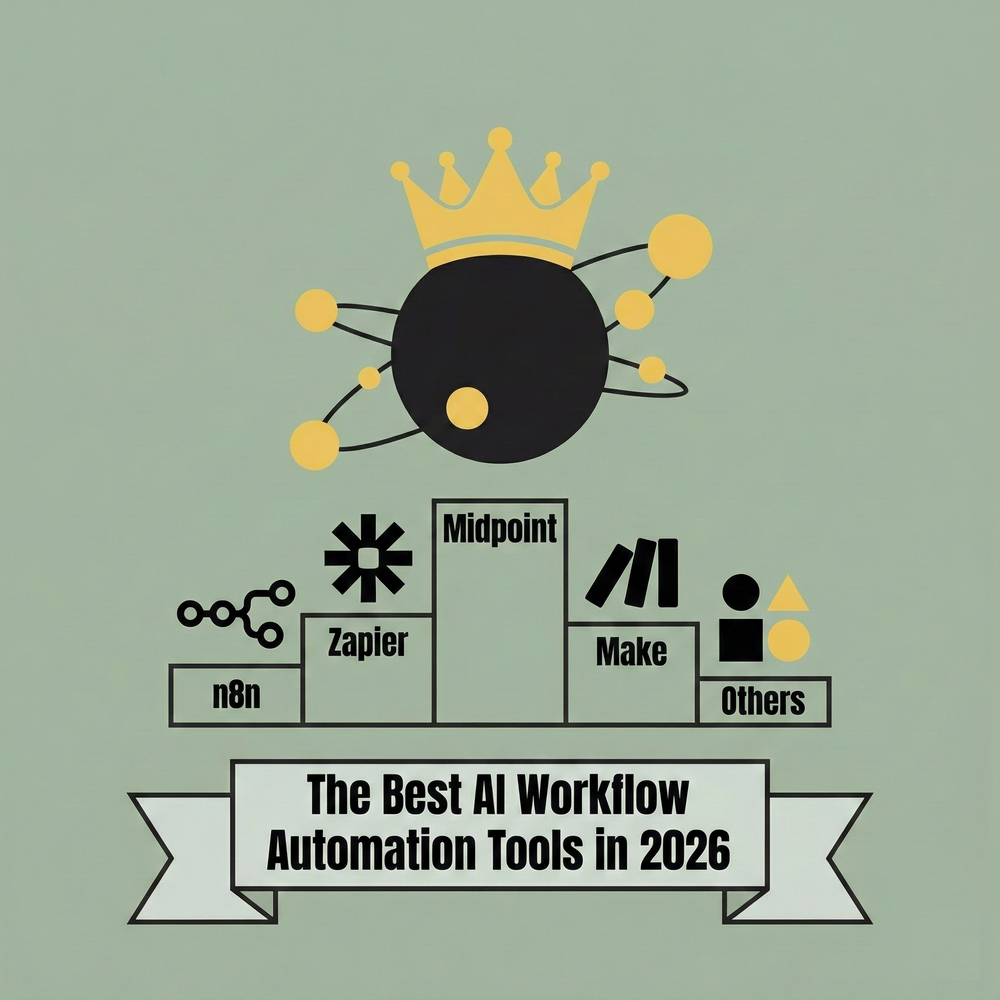
The Best AI Workflow Automation Tools in 2026
And Why Midpoint Is Pulling Ahead
AI workflow automation has changed meaningfully over the last few years.
The first wave focused on connecting applications. Moving data from one system to another. Triggering actions based on simple conditions.
The second wave is about delegating thinking.
In 2026, the most useful automation platforms are not defined by how many integrations they support or how polished their interface looks. They are defined by whether they can understand intent, compose workflows on your behalf, handle errors without manual intervention, and scale without becoming fragile.
After evaluating many of the leading AI workflow automation tools, including n8n, Zapier, Make, and newer agent based platforms, a clear pattern emerges.
Most tools still require you to build the workflow yourself.
Midpoint allows you to describe the workflow instead.
This post breaks down the best AI workflow automation tools in 2026, what each is actually good at, and why Midpoint represents a different approach altogether.
What Is an AI Workflow Automation Tool in 2026?
An AI workflow automation tool combines several capabilities that did not exist together in earlier automation platforms.
It understands natural language intent.
It reasons about steps and dependencies.
It executes actions across applications, APIs, and data sources.
It handles errors and adapts without requiring a rebuild.
Traditional automation tools move data.
AI automation tools decide what to do with that data. They handle edge cases, adjust logic dynamically, and increasingly correct themselves during execution.
The shift is straightforward.
Previously, you told systems exactly what to do.
If X happens, do Y.
Now, you describe the outcome you want.
The system figures out how to do it.
How We Evaluated the Best AI Automation Platforms
To compare platforms meaningfully in 2026, we focused on how they behave in production rather than how they look in demos.
We evaluated tools across six criteria.
First, the gap between intent and execution. How much work is required between describing a workflow and having something live.
Second, error handling. Whether failures require manual debugging or are handled automatically.
Third, scalability. Whether workflows degrade as they grow more complex.
Fourth, security and compliance. This includes credential handling, role based access, and enterprise readiness.
Fifth, flexibility. Whether workflows can evolve without breaking.
Finally, time to value. How quickly a real team can ship something useful.
The Best AI Workflow Automation Tools of 2026
1. Midpoint
Best overall AI automation platform
Midpoint is best suited for teams that want automation without wiring logic, writing scripts, or managing operational complexity.
The core capability is simple. You describe what you want to automate. Midpoint builds, tests, and deploys it.
Most automation tools require you to drag nodes, manage credentials, debug failures, and rebuild logic when APIs change. Midpoint removes that entire layer.
You might say something like:
Create a Gmail chat agent that can search emails, draft replies, send messages, and summarize conversations daily.
Midpoint then composes the workflow, connects the necessary APIs, authenticates securely, tests the entire flow, and fixes errors before it reaches production. Once live, it continues to monitor executions and correct issues as they arise.
There are no scripts to maintain.
There are no servers to manage.
There is no brittle logic to rebuild.
This is not no code automation.
It is intent based orchestration.
Why Midpoint Pulls Ahead
Midpoint generates workflows directly from natural language.
It includes built in reasoning and clarification when intent is ambiguous.
It detects and repairs errors automatically.
Authentication can be reused across workflows with a single click.
Midpoint supports REST, GraphQL, webhooks, headless browser steps, queues, and approvals. You can see executions in real time and manage everything from a single dashboard.
There is also a growing marketplace of pre built Midpoints that can be deployed instantly or published for others to use.
Execution is optimized to reduce cost per run, which matters once workflows scale.
2. n8n
Maximum control for technical teams
n8n is well suited for developers who want full control and the option to self host.
It supports JavaScript and Python steps, source available licensing, and deep customization. For teams that want deterministic control over every step, it is a powerful tool.
That flexibility comes with tradeoffs. Workflows must be designed manually. Edge cases must be handled explicitly. Errors require debugging. Infrastructure needs to be managed at scale.
n8n is powerful, but you remain the orchestrator.
3. Zapier
Simple linear automations
Zapier works well for non technical users connecting common SaaS tools.
Its strengths are a large integration library and an approachable interface. Its limitations become visible as workflows grow. Complex logic is difficult to manage. Costs rise quickly at scale. Error recovery is limited.
Zapier connects applications. It does not reason about workflows.
4. Make
Visual control for transformations
Make provides more control than Zapier without requiring code. It supports advanced branching, data manipulation, and visual transparency.
Like n8n, workflows are still designed manually. Logic must be managed explicitly. Failures require intervention.
5. Lindy.ai
Agent based tasks with constraints
Lindy is useful for lightweight assistants, inbox triage, scheduling, and voice interactions.
It becomes limiting when workflows require multiple systems, complex branching, or deeper customization.
6. Gumloop
Template driven AI workflows
Gumloop works well for getting started quickly with predefined paths. It is less suited for evolving workflows or long term scale.
7. Agentforce
Salesforce native automation
Agentforce is effective for teams deeply embedded in Salesforce. Outside of that ecosystem, flexibility is limited.
8. Workato
Enterprise governance
Workato is built for large enterprises with strict compliance requirements. It is powerful, expensive, and slow to implement. Operational overhead is significant.
9. ChatGPT Agent Builder
Lightweight experimentation
The ChatGPT Agent Builder is useful for prototyping inside the OpenAI ecosystem. It is not designed for production orchestration across systems.
Why Midpoint Wins in 2026
Most platforms assume you are responsible for designing the system.
Midpoint assumes you know the outcome. The system handles the rest.
Traditional tools require you to build workflows, debug failures, manage infrastructure, and rework logic as systems change.
Midpoint allows you to describe workflows, fixes errors automatically, removes hosting concerns, simplifies authentication, and scales elastically by default.
This is why teams increasingly replace Zapier as workflows grow, n8n when speed matters, and custom scripts when reliability becomes a concern.
Example Midpoint Use Cases
Gmail conversational agents
Automated sales briefings
Lead research pipelines
Daily meeting preparation
Support ticket translation
GitHub release monitoring into Slack
Web research written directly into Google Docs
All of these are deployed in minutes rather than weeks.
More articles
AI Agent Incident Communication Plan: Templates, Cadence, and Evidence
A practical AI agent incident communication plan with severity criteria, stakeholder templates, status cadence, evidence, and follow-up.

AI Agent Data Privacy Checklist: Controls That Hold Up in Production
A practical enterprise checklist for classifying agent data, minimizing access, controlling retention and transfers, redacting evidence, reviewing vendors, and proving incident readiness.

AI Agent Observability Tools Compared: A Practical Buyer Guide
Compare eight AI agent observability approaches by traces, tool calls, evaluations, cost, privacy, alerts, deployment, and OpenTelemetry support.