The Daily Reconciliation Digest That Catches Revenue Leaks Before They Become Fire Drills
1) Reconciliation Is Where “Small” Errors Become Expensive
Finance teams rarely lose money in one dramatic mistake. They lose it in tiny mismatches: a payment that never lands in the ledger, an amount that differs by a few dollars, duplicates that creep in during busy weeks. The problem is not that reconciliation is hard. It’s that it’s repetitive, cross-system, and easy to postpone. Midpoint makes reconciliation an automated workflow that runs on schedule and surfaces only what needs human attention.
2) The Midpoint Pattern: Stripe → QuickBooks → Exceptions → Digest
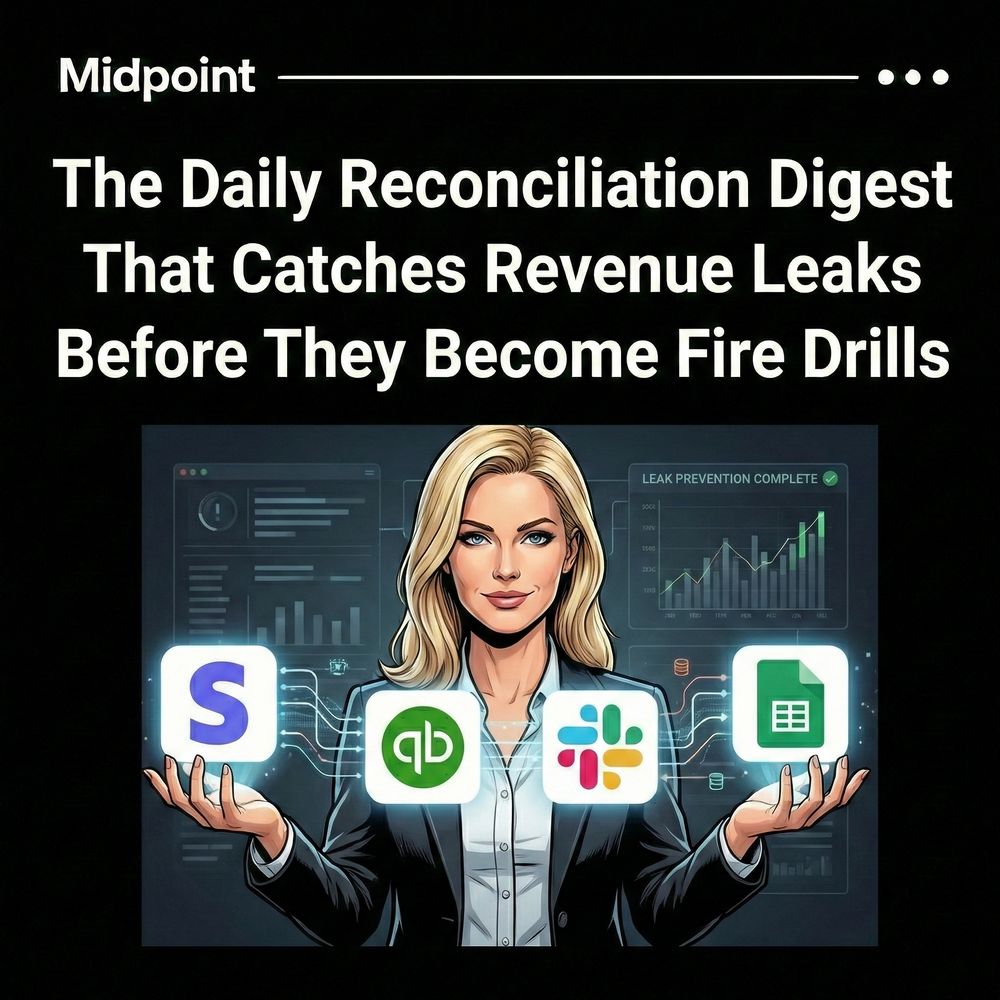
This workflow is straightforward by design: Midpoint pulls daily payments from Stripe, matches them against QuickBooks, writes exceptions into Google Sheets, then posts a summary into Slack or Microsoft Teams. Instead of living inside someone’s brain, the logic is encoded as workflow orchestration: deterministic matching rules plus exception routing. You get less manual work, faster close cycles, and fewer “wait, where did that payment go?” threads.
3) Exception Handling Is the Product
Real operations live in the exceptions lane. Midpoint flags: missing QuickBooks entries, amount mismatches, suspected duplicates, and any other conditions you define. From there, you can route exceptions to the right owner automatically, log them for audit, and trigger alerts. This is where most DIY automation fails, because it’s easy to build the happy path and ignore edge cases. Midpoint ships the system end to end so finance teams can trust it.
4) Reliability: Monitoring, Alerts, and Audit Trails
A finance automation that fails quietly is worse than no automation. Midpoint runs with observability: executions you can see in the Dashboard, alerts when something breaks, and logs you can trace. If Stripe rate limits or QuickBooks throws a transient error, retries and recovery are part of the execution model. This is how you get a workflow that runs every day without becoming a daily babysitting task.
5) Expand It Into a Finance Ops Operating System
Once the daily digest exists, it becomes a foundation. You can add: Slack threads for each exception, automatic follow-ups, approvals for write-offs, and scheduled weekly rollups into Google Docs for leadership. You can also sync to a PostgreSQL warehouse for analytics. One workflow becomes a reusable pattern, and finance stops paying the hidden tax of manual cross-checks.
More articles
AI Agent Incident Communication Plan: Templates, Cadence, and Evidence
A practical AI agent incident communication plan with severity criteria, stakeholder templates, status cadence, evidence, and follow-up.

AI Agent Data Privacy Checklist: Controls That Hold Up in Production
A practical enterprise checklist for classifying agent data, minimizing access, controlling retention and transfers, redacting evidence, reviewing vendors, and proving incident readiness.

AI Agent Observability Tools Compared: A Practical Buyer Guide
Compare eight AI agent observability approaches by traces, tool calls, evaluations, cost, privacy, alerts, deployment, and OpenTelemetry support.