How Midpoint Prepares Teams for an AI Future
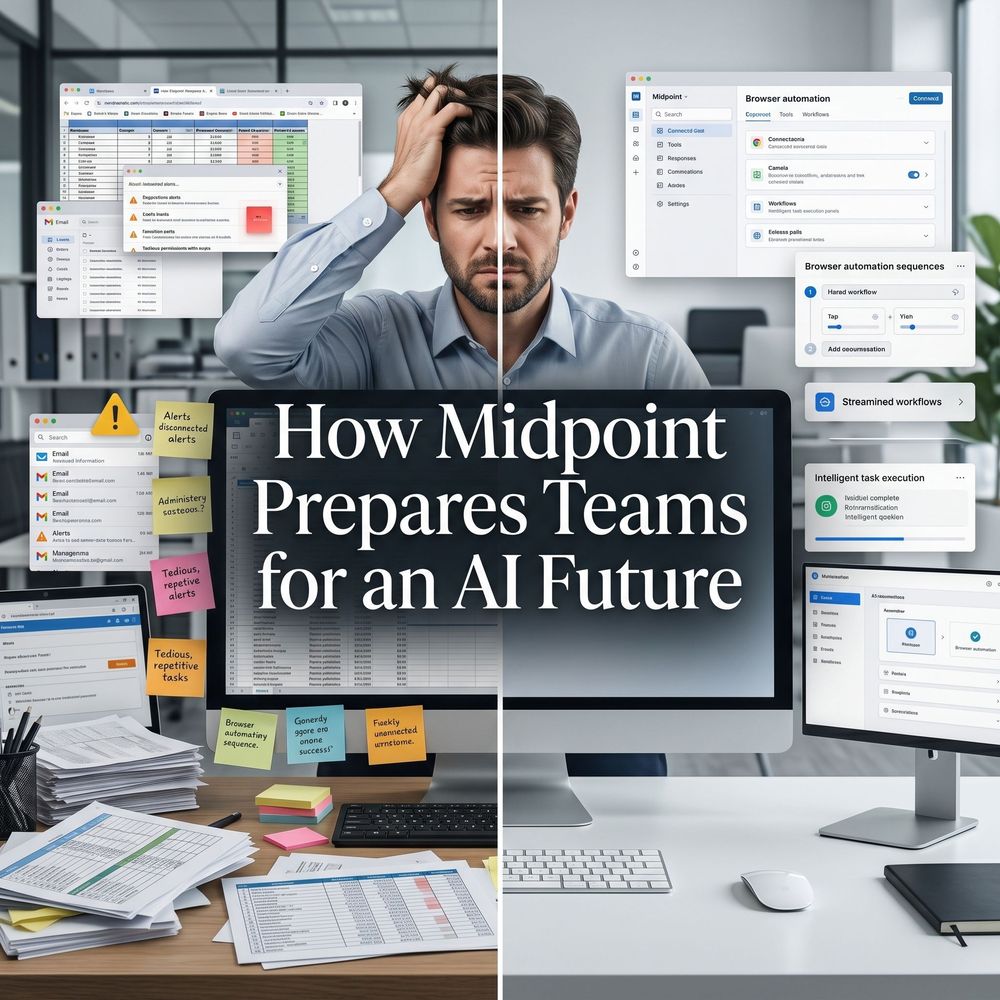
The conversation around AI is still too focused on tools. Every few months, a new model, app, or feature gets treated like the thing people need to learn to stay relevant. That framing misses the bigger shift. The people who will be best positioned for the future are not the ones who memorized the latest interface. They are the ones who understand how work gets done across systems, where the bottlenecks live, and how automation can be applied with judgment. The future belongs to people who can think clearly about execution.
That is where Midpoint comes in. Midpoint is an AI computer that can actually do work across tools, files, and websites. It is not just another chat box and it is not limited to neat API-based workflows. It can operate across the messy, real-world work that usually falls between systems, the browser steps, the portal logins, the copy and paste, the follow-ups, the repetitive admin work, and the manual handoffs that consume so much time. In practice, that means users are not just learning how to ask AI a question. They are learning how to orchestrate work through AI.
This matters because the AI future will reward people who can move from doing every step themselves to designing and supervising systems that do the work with them. That is a very different skill set. It requires understanding inputs, outputs, dependencies, edge cases, and what success actually looks like. Midpoint helps users build that muscle in a practical way. As they use it, they start to think less like task executors and more like operators. They learn how to structure messy work into repeatable workflows, how to connect disconnected tools, and how to use AI as leverage instead of treating it like a novelty.
The result is not just efficiency, it is career durability. People who know how to work alongside AI become more valuable because they can do more, oversee more, and improve more. They are no longer stuck spending their day buried in operational glue work. They can focus on judgment, prioritization, exception handling, and higher-level decision making. In other words, Midpoint does not prepare users for an AI future by teaching them a trend. It prepares them by changing how they work. It helps them build the habits and operating instincts that matter even as the models, interfaces, and vendors continue to change.
That is the real opportunity in front of every team right now. AI readiness is not about chasing hype. It is about becoming the kind of person who can direct intelligent systems to produce real outcomes. Midpoint gives users a direct path into that future. It turns AI from something abstract into something operational. And in doing so, it helps people go from overwhelmed by change to empowered by it.
More articles
AI Agent Incident Communication Plan: Templates, Cadence, and Evidence
A practical AI agent incident communication plan with severity criteria, stakeholder templates, status cadence, evidence, and follow-up.

AI Agent Data Privacy Checklist: Controls That Hold Up in Production
A practical enterprise checklist for classifying agent data, minimizing access, controlling retention and transfers, redacting evidence, reviewing vendors, and proving incident readiness.

AI Agent Observability Tools Compared: A Practical Buyer Guide
Compare eight AI agent observability approaches by traces, tool calls, evaluations, cost, privacy, alerts, deployment, and OpenTelemetry support.