Invoice Intake That Doesn’t Break: Gmail to QuickBooks, With Human-Friendly Exceptions
1) Invoices Don’t Need Humans, They Need Guardrails
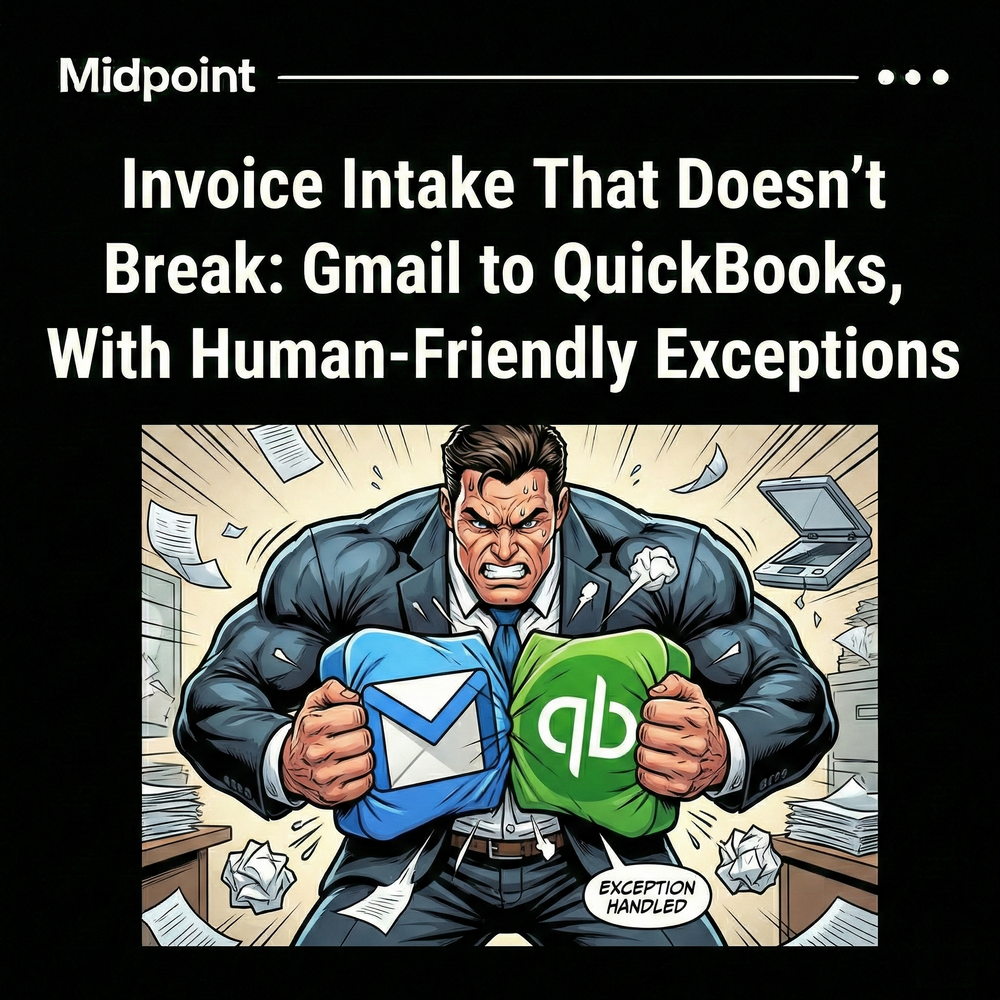
Most invoice “work” is not judgment. It’s routing, extraction, and data entry. The judgment comes in exceptions: missing PO numbers, duplicate invoices, mismatched totals, or vendor name ambiguity. Midpoint turns invoice intake into a structured workflow where humans only touch the exceptions lane, not the entire process.
2) The Workflow: Gmail or Outlook → AI Extraction → QuickBooks Bill
Midpoint watches Gmail or Microsoft Outlook for incoming invoices, then uses OpenAI, Anthropic, or Google Gemini to extract vendor, amount, date, due date, and line items. It then creates a bill in QuickBooks, logs a record in Google Sheets, and posts a summary to Slack or Teams. If you need custom steps, Midpoint can call external services over HTTP Request or execute native code.
3) Approval Gates Prevent Bad Data From Entering Your Ledger
A good invoice system is not just automation. It’s control. Midpoint can route low-confidence extractions to an approval queue, post a Slack message for confirmation, or require a reviewer when amounts cross a threshold. That is how you ship an end-to-end workflow that’s safe enough to run daily.
4) The Reliability Layer: Retries, Recovery, and Observability
Emails arrive messy. Attachments differ. Vendors change templates. Midpoint handles failures like production software: retries on transient issues, explicit error surfaces, and a dashboard view of every execution. Finance leaders don’t want “it usually works.” They want auditability and confidence.
5) Make It a Full AP Pipeline
Once invoices are entering QuickBooks reliably, you can extend the same Midpoint into: vendor master updates, PO matching, Slack approvals, payment scheduling, and month-end close checklists. Use Google Drive or OneDrive to store originals, write summaries to Google Docs, and keep an immutable log for audits.
More articles
AI Agent Incident Communication Plan: Templates, Cadence, and Evidence
A practical AI agent incident communication plan with severity criteria, stakeholder templates, status cadence, evidence, and follow-up.

AI Agent Data Privacy Checklist: Controls That Hold Up in Production
A practical enterprise checklist for classifying agent data, minimizing access, controlling retention and transfers, redacting evidence, reviewing vendors, and proving incident readiness.

AI Agent Observability Tools Compared: A Practical Buyer Guide
Compare eight AI agent observability approaches by traces, tool calls, evaluations, cost, privacy, alerts, deployment, and OpenTelemetry support.