Most “AI Agents” Are Demos. Here’s How to Ship One That Runs End-to-End
1) The Demo Trap Is Everywhere
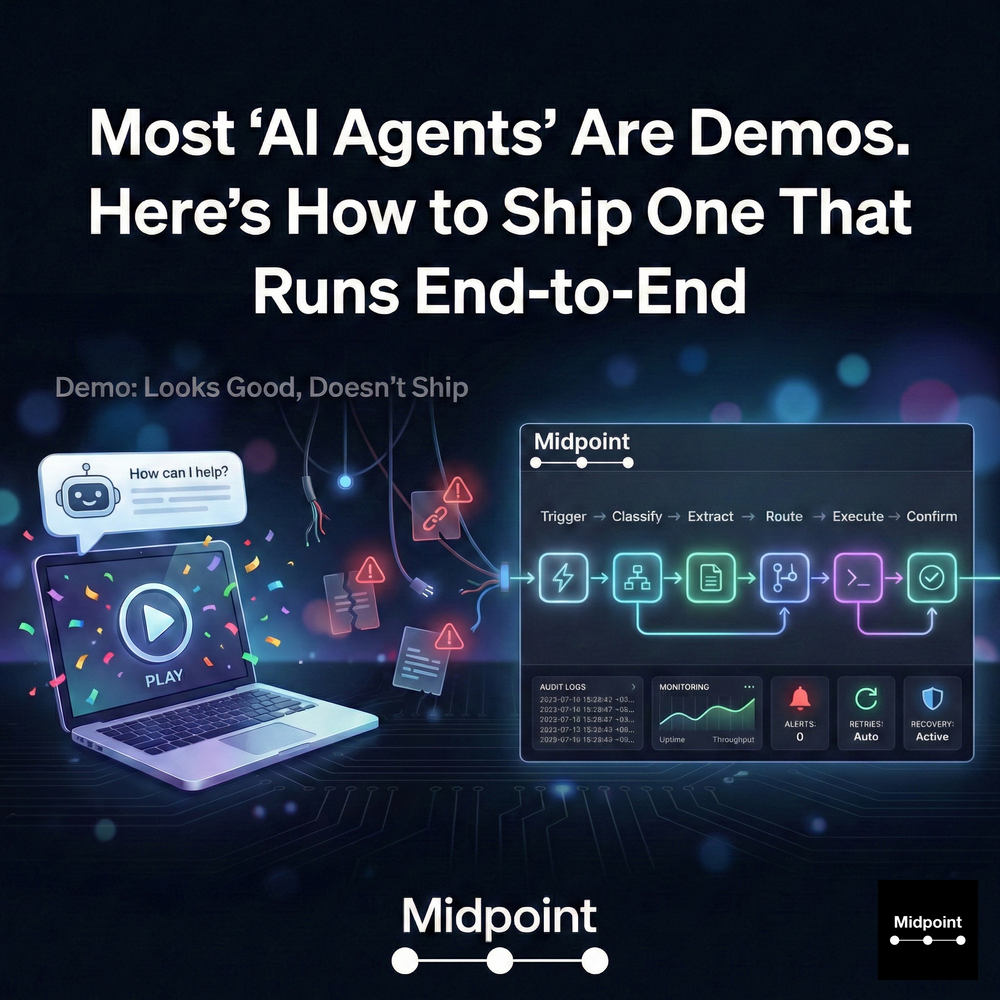
Right now, “AI agent” can mean anything from a chatbot that answers a few questions to a fully autonomous system that executes workflows across a company’s stack. The problem is that most of what gets shipped is a demo: it works once, in a clean environment, with perfect inputs, and a human watching closely. The moment you move to real operations, the agent encounters messy data, ambiguous requests, expired authentication, and edge cases that were never modeled. That is where credibility dies. Shipping an agent that runs end to end is less about clever prompts and more about workflow automation, integration platform realities, and production-grade discipline.
2) End-to-End Means More Than “It Responded”
An agent is not “working” because it generated a good answer. It is working when it reliably completes a business process automation loop: ingest, classify, extract, route, execute, and confirm. That requires AI workflows and automated workflows with conditional logic, human-in-the-loop approvals where risk is high, and consistent data sync across integrations. A real agent needs to handle triggers and schedules, accept events via APIs and webhooks, pass variables at runtime, and write outputs back into CRMs, tables, documents, ticketing systems, and chat. In other words, an agent must be a workflow orchestration system, not a single chat window.
3) The Missing Layer Is Reliability Engineering
The reasons agents fail in production are not mysterious. They fail because nobody built the reliability layer: monitoring and observability, audit logs, alerts and notifications, error handling, retries and recovery, and clear ownership when something breaks. They also fail because governance is ignored: role-based permissions, access controls, and the security posture required when an agent can touch email, customer records, payments, or internal systems. A strong agent program treats reliability as a product, with transparency and audit trails. Without that, “agentic automation” becomes another source of manual work, because humans end up cleaning up the mess after silent failures.
4) Midpoint Ships Agents Like Systems, Not Experiments
Midpoint is designed to close the gap between prototypes and production-ready automations. You describe the intent in natural language automation, Midpoint asks clarifying questions, wires the integrations across apps, APIs, and databases, builds the multi-step workflows, and tests end to end before anything ships. Then it keeps the agent running with a Dashboard that shows executions in real time, plus observability, audit trails, and ship-fixes-instantly behavior when errors appear during execution. This is managed automation, not a workflow builder that hands you the debugging burden. It is how teams move from “AI agent demo” to “AI agent that owns a process,” whether that process is inbox triage, lead routing, support translation, billing alerts, pipeline briefings, or content generation.
5) A Simple Framework to Ship Your First Real Agent
If you want an agent that runs end to end, build it like a product. Start with one high-frequency, high-friction workflow. Define the trigger (email, form, schedule, API event), the inputs you can trust, and the outputs that matter (CRM update, task creation, doc generation, Slack summary). Add guardrails: classification and extraction constraints, approvals for sensitive actions, and clear routing rules. Then add reliability: monitoring and observability, alerts and notifications, audit logs, and recovery paths. Finally, measure the ROI: hours saved, error reduction, and cycle time improvements. Most teams never reach this level because they try to do it alone. Midpoint makes it practical by taking ownership from prompt to production and ensuring the agent stays running as your stack evolves.
More articles
AI Agent Incident Communication Plan: Templates, Cadence, and Evidence
A practical AI agent incident communication plan with severity criteria, stakeholder templates, status cadence, evidence, and follow-up.

AI Agent Data Privacy Checklist: Controls That Hold Up in Production
A practical enterprise checklist for classifying agent data, minimizing access, controlling retention and transfers, redacting evidence, reviewing vendors, and proving incident readiness.

AI Agent Observability Tools Compared: A Practical Buyer Guide
Compare eight AI agent observability approaches by traces, tool calls, evaluations, cost, privacy, alerts, deployment, and OpenTelemetry support.