The Gap Is Opening: Automated Teams Are Moving Faster Than You Can Hire
1) Headcount Can’t Outrun Coordination
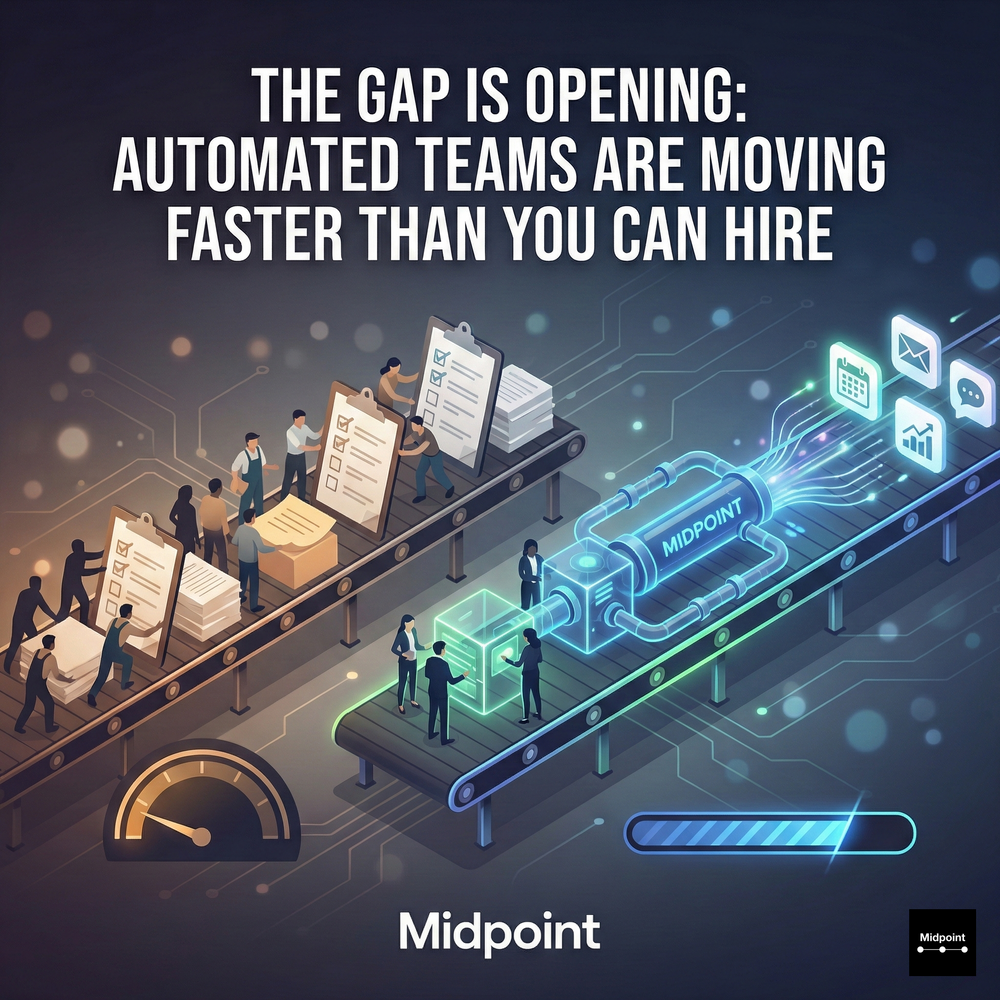
Most companies still treat growth like a hiring problem: add people, add throughput. But as stacks get more complex, every new hire adds handoffs, approvals, and coordination overhead. The result is a familiar pattern: payroll rises faster than execution speed. Automated teams operate differently. They reduce manual work first, then scale output without multiplying complexity. That is why the gap is opening. Workflow automation is becoming a compounding advantage, and it is moving faster than recruiting cycles can keep up.
2) Automated Teams Build an Operating System, Not More Process
The fastest teams do not just “use tools,” they build workflow orchestration across those tools. Lead capture automation routes and enriches records automatically. An inbound sales inbox classifies intent, updates CRM deals, and posts next steps to chat. Support triage detects language, translates, categorizes, and opens the right task. Finance runs scheduled reconciliation digests that surface exceptions with alerts and notifications. These are production-ready automations with data sync between integrations, approvals when risk is high, and clear outputs into CRMs, docs, databases, and channels. Once these automated workflows exist, teams stop redoing the same work every week, and execution starts to compound.
3) The Automation Divide Is Mostly Reliability
Many organizations have tried automation and still feel stuck. The reason is not lack of ideas. It is that DIY workflows become brittle. Auth expires, APIs change, fields get renamed, and edge cases pile up. Without monitoring and observability, audit logs, error handling, retries and recovery, automations fail quietly and teams revert to manual work. That is where the divide forms: one group treats workflow automation like infrastructure with governance and ownership, while the other treats it like a one-off project. The difference shows up in cycle time, fewer errors, and faster decisions, not just “time saved.”
4) Midpoint Closes the Gap With Prompt-to-Production Execution
Midpoint is built for teams that want outcomes, not another workflow builder to babysit. You describe what you want in natural language automation, Midpoint asks clarifying questions, wires the integrations across apps, APIs, and databases, builds the multi-step workflows with conditional logic, and tests end to end before production. Then it keeps them running with a real-time Dashboard, monitoring and observability, alerts and notifications, audit trails, and ship-fixes-instantly behavior when execution hits issues. This is managed automation that makes AI workflows and AI agents practical for real operations, not just demos.
5) Close the Gap With One Workflow That Runs Every Day
If you want to catch up quickly, do not start with an “AI strategy.” Start with one workflow that touches multiple systems and repeats weekly or daily. Examples: Form Submit → enriched lead routing to CRM; Sales Email → CRM update plus next steps summary; Support Email → translated task plus on-call alert; Stripe plus QuickBooks → exceptions sheet plus daily digest; Weekly pipeline and ops briefing → executive brief doc plus Slack summary. Add approvals where needed. Demand observability and recovery from day one. When that first automation runs reliably, the second becomes easier, and the gap starts closing. Automated teams are moving faster because their systems run while they sleep. That is the new baseline.
More articles
AI Agent Incident Communication Plan: Templates, Cadence, and Evidence
A practical AI agent incident communication plan with severity criteria, stakeholder templates, status cadence, evidence, and follow-up.

AI Agent Data Privacy Checklist: Controls That Hold Up in Production
A practical enterprise checklist for classifying agent data, minimizing access, controlling retention and transfers, redacting evidence, reviewing vendors, and proving incident readiness.

AI Agent Observability Tools Compared: A Practical Buyer Guide
Compare eight AI agent observability approaches by traces, tool calls, evaluations, cost, privacy, alerts, deployment, and OpenTelemetry support.