The Real AI Advantage: Not Models, but Monitoring, Alerts, and Self-Healing Workflows
1) The Model Obsession Is a Distraction
In 2026, it is easy to mistake progress for model upgrades. Teams debate which LLM is “best,” switch providers, and celebrate marginal gains in benchmark scores, while the real work remains manual. The truth is that most AI failures are not model failures. They are operational failures: workflows that are not observable, automations that have no clear owner, and agentic systems that cannot recover when an integration changes. If you want AI automation that produces durable productivity gains, the advantage is not the model. It is the workflow automation layer that makes systems dependable.
For incidents that automation cannot safely self-heal, use the AI agent failure recovery playbook to freeze side effects, reconcile external state, spend bounded retry budgets, and choose compensation, rollback, or roll-forward.
2) The Work That Breaks First Is Always the Same
The first cracks appear in high-frequency workflows that touch multiple integrations: lead capture automation that routes to a CRM, inbound sales inbox classification that updates deals, support triage and translation that creates tasks, scheduled financial digests like daily reconciliation, and weekly pipeline briefings that executives depend on. These automated workflows are exposed to messy inputs, shifting fields, rate limits, OAuth expiry, and human inconsistency. Without monitoring and observability, they fail quietly. Without alerts and notifications, teams learn about the failure too late. Without audit logs, nobody can prove what happened. The result is a predictable regression to manual work and spreadsheet theatre.
3) Reliability Is the Real Stack: Observe, Alert, Recover
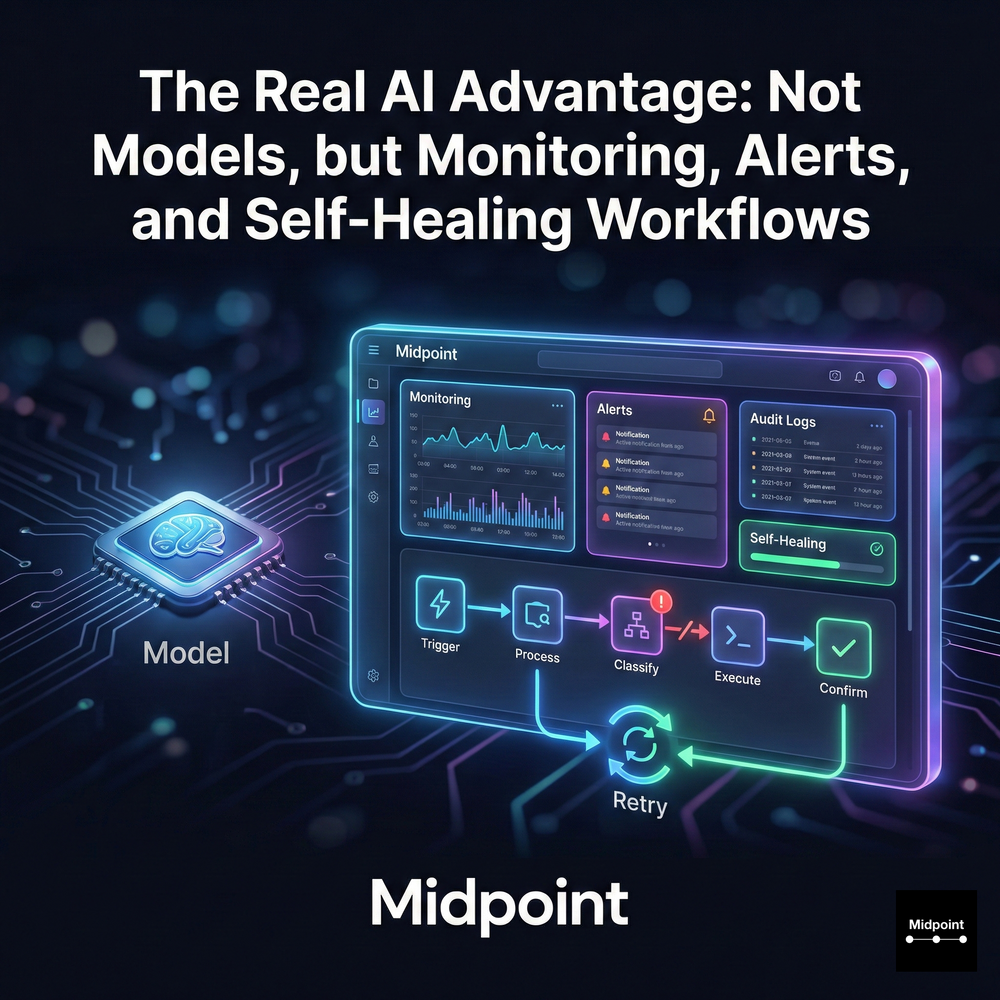
Production-ready automations require three capabilities that are routinely underbuilt. First, observability: a Dashboard that shows executions in real time, audit trails that make every step traceable, and analytics that reveal bottlenecks and failure rates. Second, proactive alerts: notifications when a workflow stalls, when exceptions spike, when a downstream system rejects data, and when an approval is waiting. Third, recovery: error handling, retries and recovery, and the ability to ship fixes instantly when an integration breaks or a condition was mis-modeled. This is the practical definition of self-healing workflows, not magic, but a disciplined approach to maintaining workflow orchestration under real-world conditions. Teams choosing the telemetry layer can use this AI agent observability tools comparison to test trace depth, tool visibility, alerting, privacy, cost, and OpenTelemetry portability before buying.
4) Midpoint Builds the Reliability Layer In, From Prompt to Production
Midpoint is designed around a direct operational promise: from prompt to running workflow. You describe the intent in natural language automation, Midpoint asks clarifying questions, wires the integrations across apps, APIs, and databases, then builds, tests end to end, and keeps it running. The “keeps it running” portion is the core advantage. Midpoint is managed automation with production support: monitoring and observability baked into the Dashboard, alerts and notifications, audit logs, and ship-fixes-instantly behavior when something breaks during execution. It is also built for real governance, with securely encrypted authentication and CASA Tier 3 security, plus role-based permissions and access controls for teams that need oversight without slowing delivery.
5) If You Want AI ROI, Measure the Unsexy Wins
The highest AI ROI does not come from a slightly better prompt. It comes from eliminating the hidden tax of manual remediation and making workflows trustworthy enough to run unattended. Start with one cross-stack workflow where failure is expensive: lead routing, billing alerts, support intake, pipeline changes, reconciliation exceptions. Define the trigger and outputs, add approvals where needed, then insist on observability, alerts, and recovery. When your automation becomes reliable, the compounding begins: fewer errors, faster execution, and measurable hours saved. That is the real AI advantage, and it is exactly what Midpoint is built to deliver across AI workflows, AI agents, and the integrations that power modern operations.
More articles
AI Agent Incident Communication Plan: Templates, Cadence, and Evidence
A practical AI agent incident communication plan with severity criteria, stakeholder templates, status cadence, evidence, and follow-up.

AI Agent Data Privacy Checklist: Controls That Hold Up in Production
A practical enterprise checklist for classifying agent data, minimizing access, controlling retention and transfers, redacting evidence, reviewing vendors, and proving incident readiness.

AI Agent Observability Tools Compared: A Practical Buyer Guide
Compare eight AI agent observability approaches by traces, tool calls, evaluations, cost, privacy, alerts, deployment, and OpenTelemetry support.