VCs Keep Predicting Enterprise AI Adoption “Next Year.” Here’s What Actually Changes in 2026
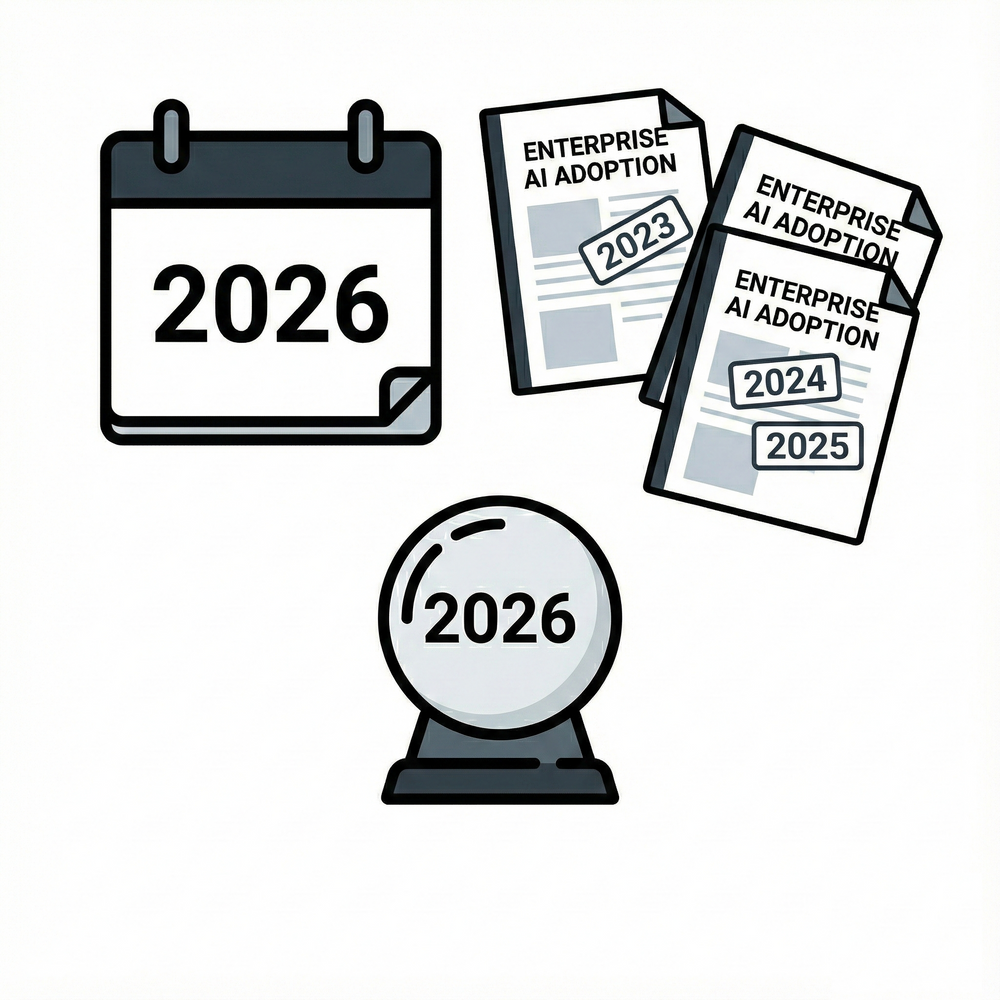
The annual ritual: “Enterprise AI adoption is coming next year”
TechCrunch just ran the same headline the enterprise market has been living through since ChatGPT’s release: VCs believe 2026 will finally be the year enterprises meaningfully adopt AI and see measurable value.
The setup is familiar:
- Massive investment and vendor proliferation
- Endless pilots
- A growing credibility gap on ROI, highlighted by research TechCrunch cites, noting 95% of enterprises were not seeing meaningful returns on AI investments
So, is 2026 actually different, or is it just the next lap of the same hype cycle?
The bottleneck was never model quality. It is operational reality.
The most useful part of the TechCrunch VC survey is not the optimism. It is the admission that enterprises are done pretending every workflow is a chatbot problem.
One investor summarized the shift bluntly: LLMs are not a silver bullet, and 2026 focus will move toward evals, observability, orchestration, and data sovereignty.
That aligns with what has been true on the ground for the last two years.
Enterprise AI does not fail because the model cannot write. It fails because production workflows require:
- Integrations and permissions
- Deterministic data movement
- Exception handling
- Approvals
- Audit trails
- Monitoring
- Ongoing maintenance when things break
AI in the enterprise does not “launch.” It either becomes infrastructure, or it dies in pilot purgatory.
Why VCs keep missing the timing
There is a reason TechCrunch could have run essentially the same prediction last year, too: VCs were already
saying 2025 would be the year enterprise AI adoption accelerates.
The pattern is consistent:
- Enterprises try lots of tools because switching costs are low early
- Teams accumulate AI sprawl across buying centers
- ROI is hard to attribute because workflows are not integrated end to end
- Security, legal, and procurement pressure increases
- Everyone pauses, consolidates, and picks winners
That experimentation trap is now mainstream management advice, not a contrarian take.
What is actually different about 2026: consolidation, not more pilots
If 2026 is the inflection, it will not be because enterprises suddenly “believe in AI.”
It will be because they stop buying AI like toys and start buying it like software that must run reliably.
TechCrunch’s follow-up piece makes the shift explicit: VCs expect enterprises to spend more on AI in 2026, but through fewer vendors, as CIOs push back on vendor sprawl and rationalize overlapping tools.
A single quote captures the procurement reality: enterprises will rationalize overlapping tools and redirect spend toward what has proven results.
Translation: budgets may rise, but distribution tightens. If you are not mission critical, you are out.
The only moat that matters: embedded workflows and switching costs
The VC survey also gets unusually practical about defensibility.
One investor frames AI moats as economics and integration, not model advantage. Companies win when they are deeply embedded in enterprise workflows with hard to replicate outcomes.
This is the key point most startups miss when they market “AI agents”:
- If your product can be replaced by a better model release, you do not have a moat
- If your product owns the workflow, the approvals, the logs, the integrations, and the business outcome, you do
What “meaningful enterprise AI adoption” will look like in practice
Forget the buzzwords. In 2026, adoption will mean:
- Fewer, broader platforms Enterprises consolidate to a smaller number of vendors that can cover multiple workflows reliably.
- From copilots to operations AI shifts from “assist me” to “run the process,” with human oversight where it matters.
- Workflow first procurement Buyers select vendors that can tie AI outputs to measurable business metrics: time to resolution, conversion rate, reconciliation accuracy, close velocity, cost per ticket.
- Governance becomes product Evals, monitoring, security posture, and auditability are no longer enterprise add ons. They are the product.
Where Midpoint fits in this story
The VC prediction cycle is basically a disguised spec for what platforms like Midpoint exist to do:
- Turn intent into a running workflow, not a prototype
- Connect across the stack: Gmail, Slack, Sheets, CRMs, databases, finance tools
- Support agent requirements: webhooks, REST and GraphQL, queues, approvals, headless browser steps
- Let teams choose models, like ChatGPT, Claude, and Gemini, based on cost, latency, or policy needs, without rebuilding the workflow each time
- Make reliability the default: end to end testing, monitored execution, and fast iteration when something breaks
That is the difference between “AI adoption next year” and “AI running in production this week.”
A practical 30 day playbook for enterprise AI that does not become shelfware
If you want to be on the right side of 2026’s consolidation, the move is not “pilot more.” It is “ship fewer workflows, end to end.”
-
Week 1: Pick one workflow that already has a KPI
Examples: invoice intake to accounting, inbound sales email to CRM update, support triage to ticket and routing. -
Week 2: Define the full lifecycle
Trigger, enrich, decision, action, logging, exceptions, human approval, notifications. -
Week 3: Instrument and harden
Add validation, dedupe rules, retries, approval gates, and audit logs. -
Week 4: Expand from the wedge
Only after the first workflow runs reliably, broaden into adjacent workflows with shared integrations and shared governance.
That is how you turn AI spend into an AI budget line item.
More articles
AI Agent Incident Communication Plan: Templates, Cadence, and Evidence
A practical AI agent incident communication plan with severity criteria, stakeholder templates, status cadence, evidence, and follow-up.

AI Agent Data Privacy Checklist: Controls That Hold Up in Production
A practical enterprise checklist for classifying agent data, minimizing access, controlling retention and transfers, redacting evidence, reviewing vendors, and proving incident readiness.

AI Agent Observability Tools Compared: A Practical Buyer Guide
Compare eight AI agent observability approaches by traces, tool calls, evaluations, cost, privacy, alerts, deployment, and OpenTelemetry support.