What “End-to-End” Actually Means for AI Agents
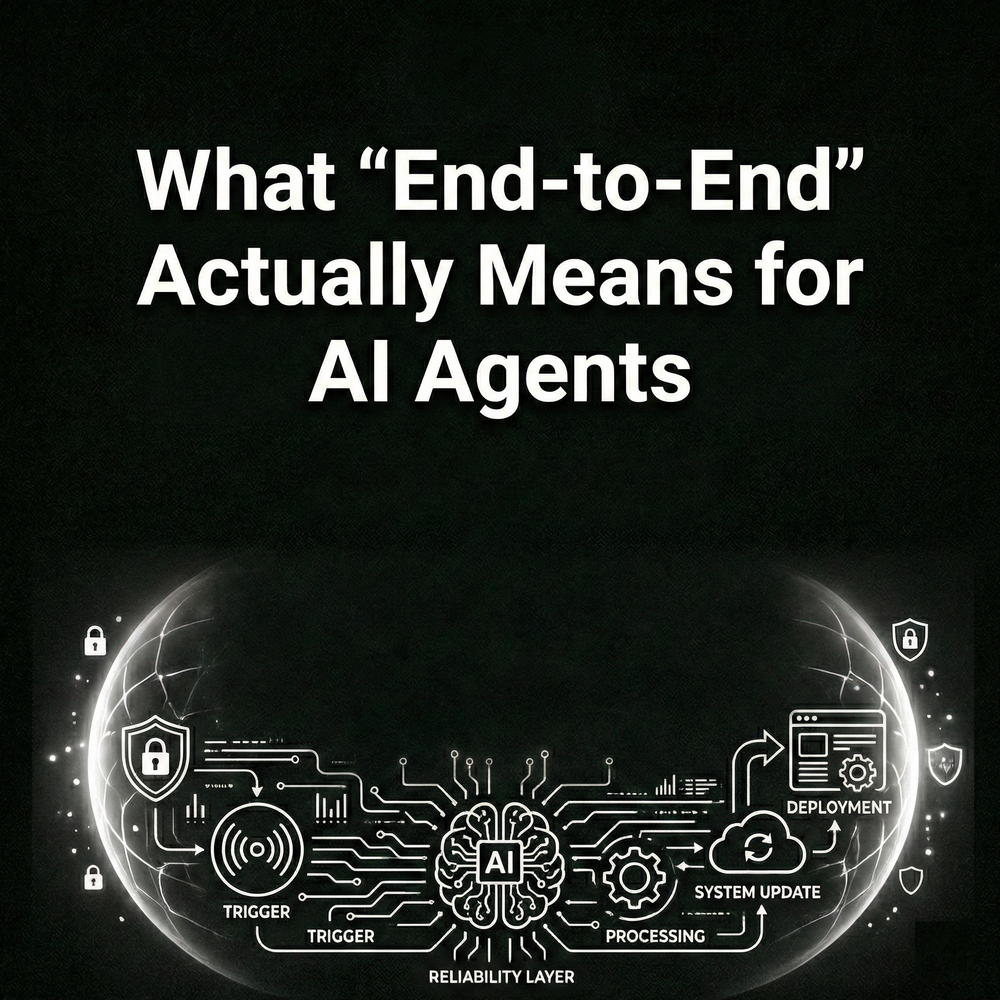
1) End-to-End Means the Work Closes the Loop
An agent isn’t end-to-end if it produces a message and stops. End-to-end means it takes an input, transforms it, executes actions across systems, and confirms completion in the system of record.
2) The Pipeline Every Real Agent Needs
Trigger, context, decision, action, confirmation. You need data pulls from your stack, deterministic rules where safer, and AI where classification or extraction is required.
3) Approvals Are Not Optional
If an agent can take irreversible actions, it needs approvals and confidence thresholds. This is how you scale agents without losing trust internally.
4) Reliability Is the Product
Monitoring, alerts, audit logs, retries, recovery. This is the difference between demos and deployments, because production breaks in boring ways, auth expires, schemas change, edge cases appear.
5) End-to-End Agents Create Compound Speed
Once a workflow runs reliably, it becomes an operational primitive. The team stops redoing the same work and starts compounding throughput.
Choosing the right execution model matters before implementation. Use AI Agent vs Workflow Automation: How to Choose to decide when a process should use rules, an adaptive agent, or a hybrid of both.
More articles
AI Agent Incident Communication Plan: Templates, Cadence, and Evidence
A practical AI agent incident communication plan with severity criteria, stakeholder templates, status cadence, evidence, and follow-up.

AI Agent Data Privacy Checklist: Controls That Hold Up in Production
A practical enterprise checklist for classifying agent data, minimizing access, controlling retention and transfers, redacting evidence, reviewing vendors, and proving incident readiness.
AI Agent Observability Tools Compared: A Practical Buyer Guide
Compare eight AI agent observability approaches by traces, tool calls, evaluations, cost, privacy, alerts, deployment, and OpenTelemetry support.