Chase overdue invoices
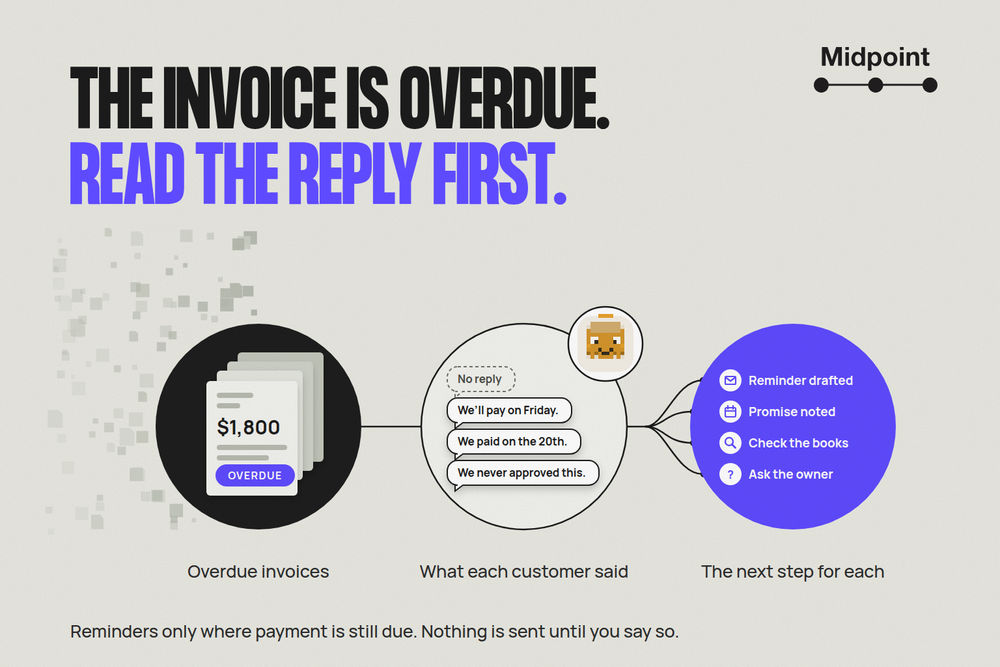
Before you chase an overdue invoice, you need to know what the customer last said. The invoice may say unpaid, but the customer may already have promised a date, questioned the bill or sent a payment your books don't show yet. Chase without checking, and you annoy the customer who already did the right thing.
Priya runs a small design agency with four invoices past due. She gives the checking to her Midpoint worker: "Look at these overdue invoices and the customer emails about them. Draft a reminder only where the money is still owed. Bring me anything that needs a different next step. Don't send anything."
The worker returns a short list. Each line shows the invoice, what the customer last wrote and what to do next. She isn't lining up an aging report against her inbox. She has the records and next steps together, ready to review.
One customer is simply late
The first invoice is for $1,800, due on October 12. The customer hasn't paid, and nothing in the books or the emails says otherwise. The worker drafts this and leaves it unsent:
Subject: Quick check on invoice 1042
Hello, I'm following up on invoice 1042 for $1,800, due on October 12. Could you let me know when payment is scheduled? If you need another copy of the invoice or have a question about it, just reply here.
The draft sits beside the invoice and the last email the worker checked. Priya reads it, changes a word if she likes, and sends it herself. If she waits a day, she can ask the worker to check again for a new payment or reply before she sends it.
Another customer already answered
The second customer wrote, "We'll pay on Friday, October 30." The worker notes that as a promise, not a payment. The invoice stays unpaid until the books show money received. Priya chooses November 4 for the next check. The worker records that date and prepares no reminder in the meantime.
The third customer wrote, "We paid this on the 20th." The worker checks the recorded payments. If nothing matches, it doesn't draft a nudge and it doesn't mark the invoice paid. It sends the question to Priya or her bookkeeper: here is the email, here is what the books show, and they don't agree. The customer's email alone isn't enough to mark the invoice paid.
The fourth customer wrote that the invoice includes work they never approved. The worker returns the invoice, the customer's own words and the question only Priya can answer. It drafts no reminder, because a friendly nudge would ignore what the customer said.
So her morning list reads like this:
- Ready to review: one reminder for the invoice that is still owed, with the amount and the last email beside it.
- Wait for the date: the customer who promised October 30, and when to look again.
- Needs you: the payment that doesn't match the books, and the disputed charge.
A draft isn't money collected. If the worker can't check a balance, an address or an email thread, it says what's missing instead of guessing.
When your accounting software is enough
If you only want the same polite reminder to go out before and after the due date, start with the settings you already have. Xero, for one, offers automatic payment reminders before, on and after the due date. Services built for collecting payments exist too, and some already read replies. A plain template is enough if all you need is one standard message.
A worker is worth trying when you want someone to do the checking across your invoices and your inbox, then come back with the few cases that need you. What you get is the checking done for you. Reminder schedules and polite wording are nothing new.
Ask the worker to check whether your accounting software or a collections service already sends reminders. Then pick one, so nobody gets chased twice.
What stays with you
The worker gets the follow-up ready. It doesn't send messages, change your books, give discounts, add fees, change bank details or settle a dispute. Those decisions stay with Priya. It also can't promise to find every reply, so finding none doesn't mean the customer never wrote.
Hand it over
This is different from preparing incoming supplier invoices for QuickBooks, where the question is which bills you should pay. Here the question is who owes you. If the payment records disagree, the next job is a reconciliation review, not another reminder.
Your Midpoint worker has its own computer. Connect your accounting and email accounts, or give it an approved invoice export and the related replies. An export is a snapshot, so it is only as current as the day you pulled it. Tell it which business to check, how long to wait after a promised date and who handles disputes.
Then ask: "Check these overdue invoices against the latest customer replies. Draft reminders only where payment is still owed. Bring me payment claims, disputes and the dates to follow up on. Don't send anything or change the books."
More articles
AI Agent Incident Communication Plan: Templates, Cadence, and Evidence
A practical AI agent incident communication plan with severity criteria, stakeholder templates, status cadence, evidence, and follow-up.

AI Agent Data Privacy Checklist: Controls That Hold Up in Production
A practical enterprise checklist for classifying agent data, minimizing access, controlling retention and transfers, redacting evidence, reviewing vendors, and proving incident readiness.

AI Agent Observability Tools Compared: A Practical Buyer Guide
Compare eight AI agent observability approaches by traces, tool calls, evaluations, cost, privacy, alerts, deployment, and OpenTelemetry support.